Sephiria Tablets: The Four Effect Families
TEAM HORAY says Sephiria has about 70 tablets. The most careful community dataset catalogues 62 with full mechanics, and its maintainer believes at least one is still missing. Neither number is wrong; they are counting different things.
What matters more than the count is that tablets fall into four mechanically distinct families, and knowing which family a tablet belongs to tells you where it can go before you read a single number.
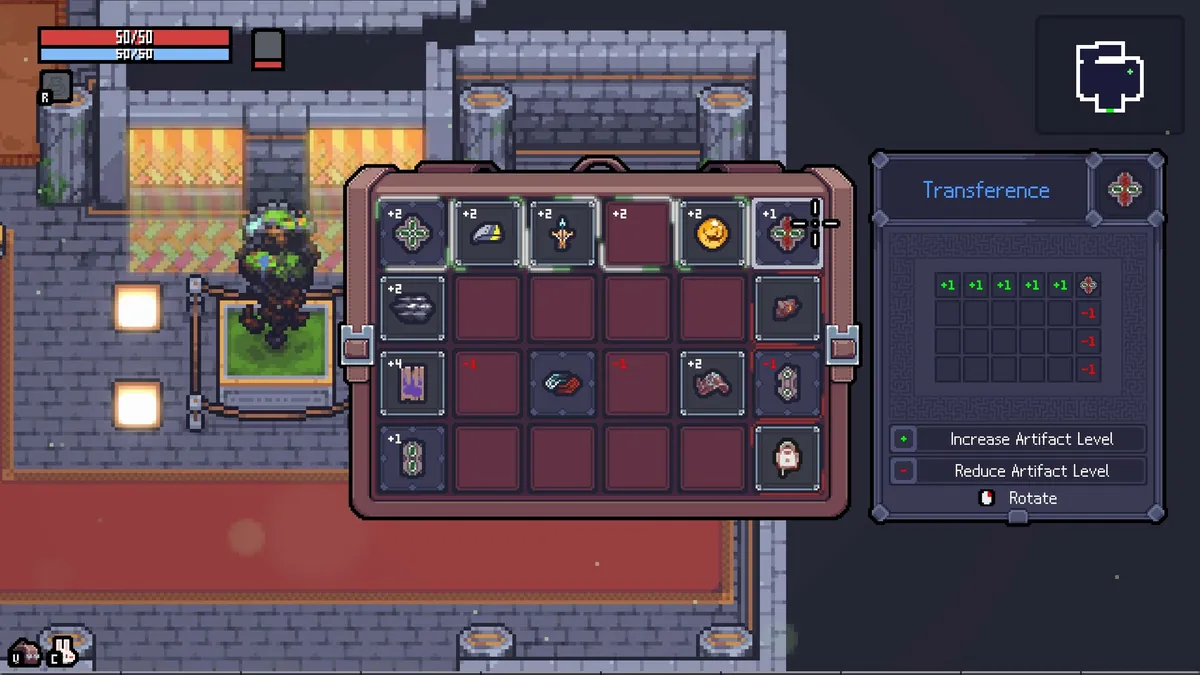
Family 1 — discrete offsets
The largest group. The tablet buffs specific cells at fixed relative positions.
Footprint sizes across the dataset: 1 cell (12 tablets), 2 cells (15), 3 (8), 4 (10), 5 (4), 6 (2), and 8 for Thorns, the widest. Ten tablets have no discrete cells at all because they belong to another family.
Two hard limits worth memorising: maximum reach is 3 cells (Manhattan distance), and the largest single-cell buff is +5, held by Conviction.
Twelve tablets carry negative cells — Exploitation, Unity, Gaze, Nurture, Competition, Advent, Wave, Trick, Disconnection, Last Stand, Flag and Defensive Move. A careless layout with these actively lowers your artifact levels. They are not traps; they usually pay for their debuff with a larger buff elsewhere in the same pattern. But you have to place them deliberately.
Family 2 — line buffs
Twelve tablets buff an entire row, column or diagonal. Some reference themselves; others anchor to a fixed grid line.
Miracle, Transference, Cohesion, Justice, Shade, Vigilance, Foundation, Brilliance, Simultaneity, Rebellion, Courage, Requital.
Requital is the strongest single line effect: +3 to its entire row. On a 6-wide grid that is +18 of distributed value from one cell. Foundation and Simultaneity are the +1 workhorses, and Foundation matters disproportionately because the Endure talent at level 5 hands you one at the start of every run.
Line tablets are what you build a layout around. Place one first, then stack discrete tablets onto the cells you want lifted highest.
Family 3 — board parity
Exactly one tablet: Curse, obtained from the Skeleton costume.
It applies a chessboard pattern across the entire grid — odd cells +1, even cells −1. A cell at offset (dx, dy) counts as odd when dx + dy is odd.
Three consequences that make it unlike anything else:
- Its own position does not limit its reach. It always covers the whole board.
- The parity of the cell it sits on decides which colour gets the buff — move it one cell in any direction and the entire pattern inverts.
- Rotation does nothing.
Two parity tablets on same-parity cells stack; on opposite-parity cells they cancel exactly.
Family 4 — edge-anchored
Four tablets are inactive unless placed on a specific grid edge:
| Tablet | Required edge |
|---|---|
| Good Will | bottom |
| Shade | top |
| Flag | left |
| Justice | left or right |
Off their edge they contribute nothing while still consuming a cell. Community tooling flags them explicitly as "INACTIVE (needs edge: …)" because this is the single most common layout mistake.
Place these first when planning, or do not pick them up.
Rotation
Tablets rotate in 90° steps with R, or since patch 1.0.19 with a middle mouse click.
But 18 of the 62 cannot be rotated at all: Good Will, Justice, Destiny, Shade, Desire, Vigilance, Cheers, Foundation, Distribution, Three-Headed, Dry, Simultaneity, Disconnection, Thorns, Entrance, Exit, Hospitality, Flag.
A further 14 are rotatable but symmetric, so only one or two rotations are actually distinct — spinning them is wasted effort. Self-referential row and column buffs swap axis at 90° and 270°; diagonal line buffs flip direction.
The full name list
In dataset order: Hope, Miracle, Transference, Exploitation, Cohesion, Good Will, Justice, Unity, Destiny, Chivalry, Wit, Gaze, Pulsation, Nurture, Shade, Binary Star, Link, Competition, Desire, Advent, Vigilance, Wave, Trick, Dedication, Cheers, Harvest, Advance, Foundation, Distribution, Three-Headed, Past, Future, Stack, Brilliance, Handshake, Approximation, Power, Compression, Dry, Simultaneity, Disconnection, Daydream, Thorns, Rebellion, Conviction, Preparation, Entrance, Exit, Oaths, Peace, Courage, Hospitality, Honor, Junction, Rally, Progress, Last Stand, Flag, Defensive Move, Requital, Curse, Wedge.
One naming note: a 2025 patch describes a tablet called "Spike" whose effect matches the current Dry. No tablet named Spike exists in the current game. If you find it referenced somewhere, that page predates the rename.
Where tablets come from
Tablet nodes, shops, the Mystic Pot in its pre-1.0 form (which converted artifacts into tablets), and the Endure talent's level-5 Foundation. One tablet is exclusive to the Dimensional Rift and two more to the Wandering Witch.
Critically, tablets are gated content: the free Tablet node in Destiny Inscription must be purchased before tablet nodes or tablet objects appear in runs at all. It is the first thing to buy.
Merging with the Tablet Combiner
Added in patch 0.10.14, the Tablet Combiner appears in every Safe Zone after Wasteland, next to the merchant. It costs 200 Leaf and works once per combiner.
The merge rules, as modelled by the community solver:
- Both sources' discrete effects combine, baked at whatever rotations you chose at merge time.
- Both sources' line buffs combine.
- The result is non-rotatable if either parent was.
- Parity effects carry over; if both parents had one, the odd and even values sum.
- Edge requirements: neither parent → none. One parent → inherited. Identical → inherited. One set contained in the other → the narrower wins.
Disjoint or partially overlapping edge requirements are blocked, on the explicit grounds that the in-game behaviour is unconfirmed. That is a sensible position to copy rather than experiment with, because a merge is irreversible and the combiner is one-use.
The obvious high-value merge is a line tablet into a strong discrete tablet — Requital plus Conviction gives you +3 across a row and +5 on one cell, from a single occupied slot.
What changed in 1.0.19
The only tablet balance in the 1.0 window:
- Nurture rarity Advanced → Common
- Trick rarity Advanced → Common
- Competition downward bonus +2 → +3
- Wave upper-right diagonal +2 → +3
- Preparation lower-right diagonal +1 → +2
- Daydream reworked from "+1 on each of the 4 diagonals plus +1 on the 4 cells beyond" to "+2 on each of the 4 diagonals" — fewer cells, higher values
Patches 1.0.21 through 1.0.24 contain zero tablet balance changes. One tablet-adjacent fix landed in 1.0.23: the Alchemy combo failed to trigger when a tablet was obtained directly into the Side Bag.
Where placement is explained
This page is the taxonomy. How buff values become artifact levels, how to engineer a high-value cell, and how Tablet Engraving frees up slots are covered on the inventory grid page.
Checked against 1.0.30
Four tablet-related fixes landed in August and none of them changes a value on this page. 1.0.26: tablets no longer appear in the Subspace Shop's unlock list before you have made a Destiny Inscription; Tablet Inscription no longer shows up as a battle-zone reward when it has not been unlocked; and tablet effects that silently failed in certain language settings now work. 1.0.30: Tablet Imprinting no longer consumes the tablet without imprinting when its activation conditions were not met; tablets that cannot be discarded can no longer be fed into the Tablet Combiner; and switching costume with a full inventory no longer loses the tablet you were owed.
Provenance
Mechanical detail here comes from an open-source community dataset whose values match the 1.0.19 patch notes exactly on every item they both cover — Competition +3, Wave +3, Preparation +2 and Daydream's four diagonals all line up. That agreement is why we are willing to cite it for things TEAM HORAY has never published. It is still not a developer document, and the tablet count remains genuinely unsettled.
- Steam announcement '1.0 Update' 31 Jul 2026 — ~70 tablets, 1.0.19 tablet balance
- Steam announcement 0.10.14/0.10.15 — Tablet Combiner
- SephiriaSolver open dataset and rules spec (forestsquirrel.github.io/SephiriaSolver, TABLETS.md)
- Steam Community Guide — 'How to place tablets for best configuration' by ForestSquirrel